
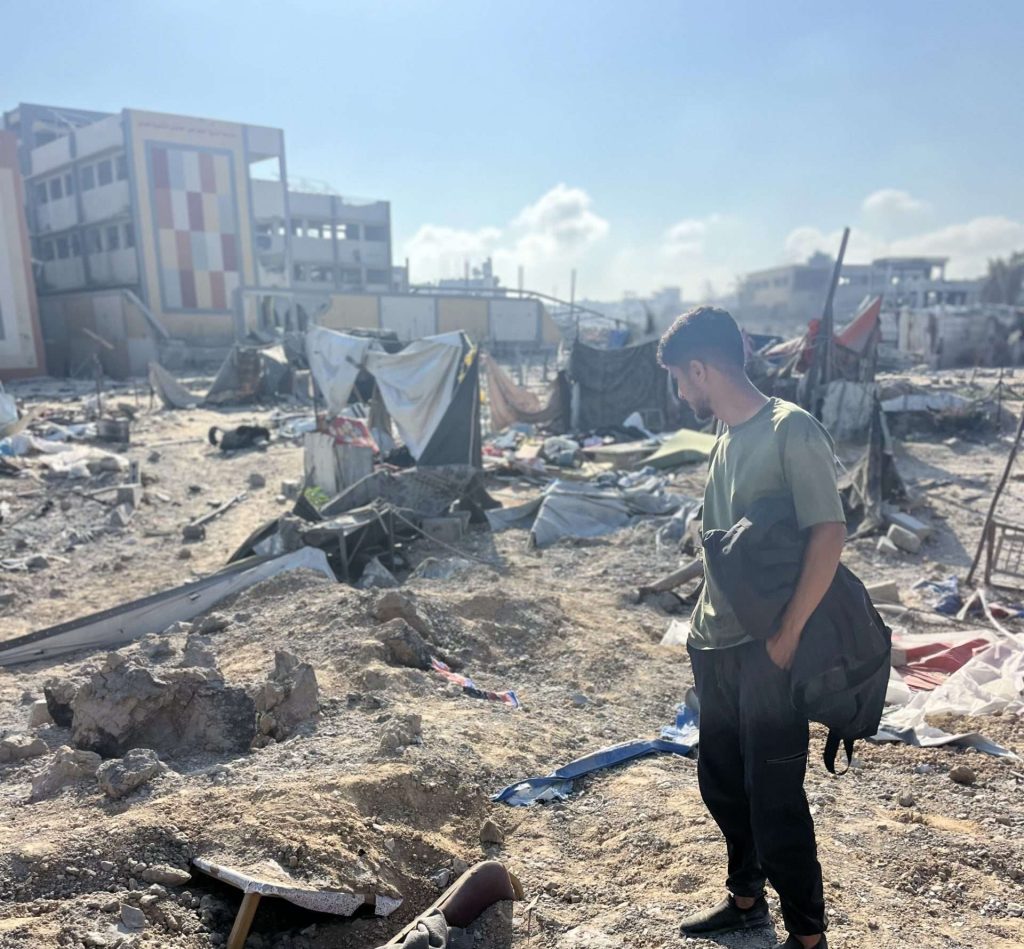
“I don’t just want to study for myself; I want to gain the knowledge to help the world”: UofG prospective student Qusay Alregeb currently faces unaffordable tuition and travel fees. Without the necessary funding, he may miss the 2026 cohort of offer holders.
When Qusay Alregeb graduated from high school in 2023, he did not anticipate that his academic ambitions would come to a halt. Qusay, 20, received an unconditional offer from the University to study a BSc Honours in Computing Science on 12 January 2026. He demonstrates a promising academic trajectory, having achieved an average of 97.4% across his subjects, including 100% in physics. Yet, under the constraints of genocide, Qusay has been trapped in Gaza, unable to start his journey to the University of Glasgow.
This month, The Glasgow Guardian spoke to UofG prospective student Qusay to discuss the financial challenges he faces. Whilst he may possess the academic achievements to study at a UK Russell Group university, Qusay notes that he requires the financial stability to “save” his “future from being lost to this war”. He says: “I am not looking for a political debate; I simply want to share my story as a student who fought for his education and is now fighting for his right to attend the university that accepted him”.
In need of sponsorship for his journey, Qusay has since set up a GoFundMe to support his further education. This alone, however, is not enough. Qusay says that his “primary goal” is to “find an official organization or a corporate sponsor to provide a full academic sponsorship” for his undergraduate degree. He adds, “As a student, my only realistic hope of reaching Glasgow is through a formal evacuation coordinated by the British Embassy. Without such high-level intervention, I remain trapped despite my unconditional offer”. For Qusay, a chance to study at the University of Glasgow is also an opportunity for refuge. Unlike other international students who travel to the UK to study, “securing a visa is not [his] primary hurdle”. Instead, he looks to sponsorships and scholarships.
Despite also being offered the World Changers Global Excellence Scholarship, a grant of £10,000 towards annual tuition fee for International and EU Undergraduate students, Qusay’s original offer is based on the International tuition fee status of £33,210 for the 2026-27 academic year. This is an increase of £1410 from the 2025-26 academic year. On top of this, he still has to consider travel, accommodation, food, and academic resource costs. The University of Glasgow estimates that the living and study costs in Glasgow’s West End for students total £1,100 to £1,700 per month.
Qusay is one of many whose livelihoods and education have been disrupted by Israel’s occupation and strict blockades. “My dream is to go from a tent in Gaza to the labs at the University of Glasgow,” he tells me. I find myself lingering over these words on my laptop, and it becomes clear to me that the only distance between Qusay and me is geographical. If Qusay had the opportunity to pursue further education in 2023, he may have already been a member of a shared student society or a classmate in a lecture, completing his penultimate year of study.
Qusay tells me that he has “been out of the classroom for nearly two years now”. He adds that “before the conflict,” his aspirations were — and still are — “to specialise in Artificial Intelligence and Software Development, to build tools that help rebuild society and support education in crisis zones. I don’t just want to study for myself; I want to gain the knowledge to help the world”.
He reminisces about the stability of his life before 2023, and the steady income from his father working as an engineer. “Since the first day of the conflict, [his father] has been out of work with no income for over two and a half years, ” says Qusay. Without access to savings, the annual maintenance costs in Glasgow alone are simply unrealistic. He describes his financial state as “catastrophic”, and tells me that with no income or home, “the tuition fee of £33,210 per year is a wall I cannot climb alone”.
At the moment, Qusay lives in a tent with his family, a total of 11, including his parents, four sisters, four brothers, and Qusay himself. Living by the sea for almost a year, he says “sharing a single tent with ten other people while trying to maintain hope and academic focus is incredibly difficult”. But this has not discouraged him. Alongside the help of St. Andrews student Fergal Ronan Harte, Qusay’s fundraiser has raised £8,446 and 370 donations as of 16 April 2026.

When I ask Qusay why he chose Glasgow, he says he admires the University of Glasgow for its global reputation, referring to UofG as a “University of Sanctuary”. He chooses Glasgow for its “community that values academic potential over tragic circumstances”. Qusay’s “passion for technology”, he hopes, will assist the growth of his career and support his family back home.
The University of Glasgow offers the Dima Alhaj Scholarship, currently the only fully-waived scholarship specific to Palestinian nationals, and applicable to Qusay as an undergraduate student. The Dima Alhaj scholarship provides a full tuition fee waiver, an annual £9,010 towards living costs, UofG accommodation, Visa/Health charges and a flight to Glasgow. However, whilst Qusay has applied for the scholarship, it remains highly competitive and only rewards spaces to one undergraduate and one postgraduate student. In other words, although the Dima Alhaj Scholarship provides tremendous support for its successful applicants, its limited numbers and room to only financially assist one undergraduate Palestinian student a year is not enough for Qusay — and many others — to rely on.
To help support Qusay’s tuition fees and living expenses, please visit his GoFundMe: https://www.gofundme.com/f/help-qusay-escape-the-tents-of-gaza-to-glasgow-university
Image credits: Qusay Alreqeb

1 thought on “Gazan Student’s Journey to Glasgow may not be Possible, Despite Unconditional Offer”
Brilliant article!