
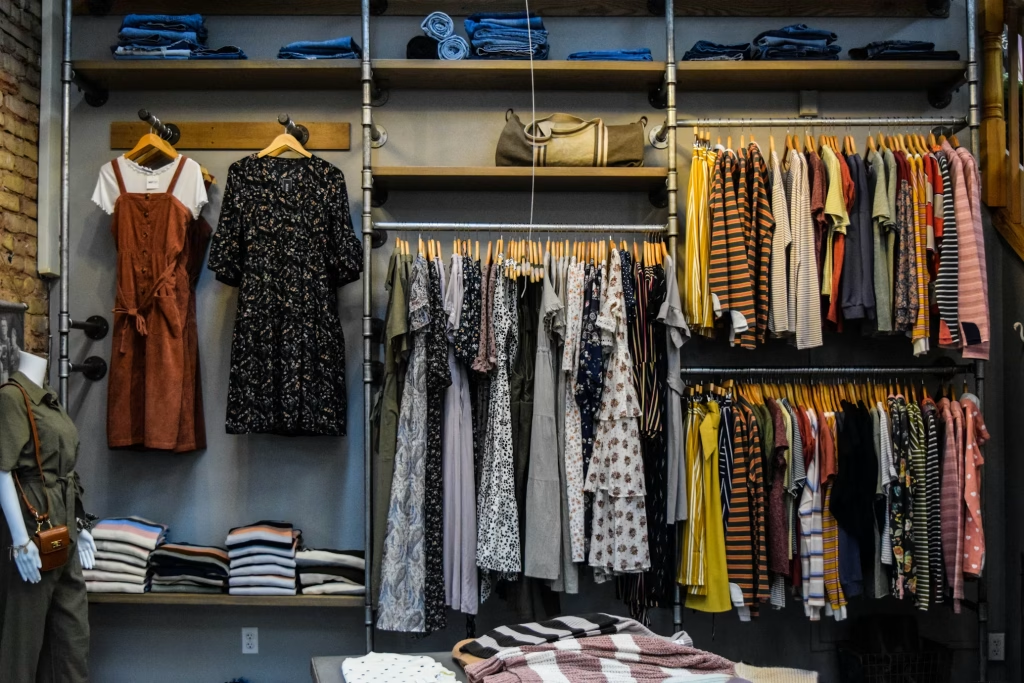
Can personal style and art truly be authentic forms of self-expression?
How authentic is authenticity? When it comes to personal expression in art and fashion, the word “authenticity” itself seems to be the holy grail of the creative, “cool” student. But the pressure to constantly curate and maintain self-expression is tiring and almost always directly contributes to the economic gain of our greedily consumerist society. Maintaining a unique self image and art style is where the difficulty lies: the “upkeeping” and “renewal” of something that’s true to your own vision seems juxtapositional, because it sounds suspiciously like jumping on and off artistic bandwagons, lacking core identity and endlessly searching for the “self”.
Social media has an undeniable part to play in this quandary: the term “core”, which is vastly overused to describe every subculture and sub-subculture, suggests being at the “heart” of someone’s expression — the central element. Surely this is where authenticity should lie? Yet, the abuse of the term directly mirrors the overconsumerist nature of fast fashion, which often finds itself at the forefront of the style you aim to replicate, reducing personal identity into something so specific that it simply cannot be sustainably genuine.
Take the recent push on whimsicality; perhaps in defiance of the minimalist “clean girl” movement, which skyrocketed to the mainstream following Hailey Bieber’s debut of the oversized blazer-slick-back combo in 2022. Whimsicality, by contrast, is recognised in its playful elements — rejecting the “clean” uniformity. Though, this too is packaged and sold through uniquely patterned clothes and colourful home accessories, such as themed mugs and water bottles for every occasion of the year, or “vintage” wooly jumpers that were made in factories last year under law-breaking conditions. These items are framed as essential to embracing a nostalgic mindset, to re-immersing oneself in a world before polished, restrictive aesthetics and mass-produced trends were all consuming. But will the pieces bought to embody this mindset end up discarded when the next “alternative” movement comes around?
The same goes for an artistically framed Instagram dump, a thoughtfully curated playlist, or even the “niche” that the contents of your sketchbook fit into. Comfortable, well regarded authenticity, it turns out, needs an audience who understands the reference points, which, crucially, cannot be everyone. Continuity between art forms is pushed, while if art requires constant renewal to remain relevant, who benefits from that pattern? And how do we find authentic expressions which don’t feel like maintaining the cycle of a desired, unachievable persona?
It seems counterproductive when discussing originality in art to discuss copying, but perhaps this is what we must embrace. Elaine Sturtevant famously recreated artworks by renowned artists such as Warhol, Beuys and Lichtenstein in her “Double trouble” exhibit at the MoMa. Yet her art wasn’t about how easy it is to copy popular works of art, it was about copying the act of copying. She treated their famous styles as a kind of script that anyone can replicate, revealing that circulation and recognition are what make something renowned for its originality. Forgery and plagiarism are a grand way of illuminating how this process works, but prove that there is no real “original”. Taking inspiration and learning through mimicking are vital skills that we cannot eliminate for the sake of innovation. Students learn from their superiors to gain expanded skill sets, and are influenced by their peers to discover in themselves what makes them feel like themself. Taking inspiration is not the enemy of originality, but it makes me wonder who gets to claim authenticity and who doesn’t.
From a social standpoint, authenticity is never judged equally. What reads as “quirky” for one person, reads as “too much” for another; with gender, class, and race playing crucial roles in this judgement. For instance, masculinity is highly policed: dismissing expressive choices of dress, or engagement with textile or needlework as “fruity” or performing solely for female attention, much like how for women, playing with colourful or striking makeup damns you as vain or superficial.
Class difference has, perhaps, one of the clearest impacts on style: while thrift culture is romanticised amongst students, outside this rarefied bubble the act of second-hand shopping carries a lot of social stigma — ironically and predictably for those who are most in need of affordable clothing. Those who are able to afford the trial and error involved in curating a fashionable second-hand wardrobe are praised for being “resourceful”, yet necessity is often read as lack rather than creativity, reaffirming the classed nature of taste.
Equally, racial divides in power mean that cultural aesthetics are stolen, artfully repackaged, and then monetised, while the communities that originated them are given no credit or chance for collaboration, and perhaps even scrutinised for the same expression. The “Scandinavian scarf” went viral in 2025, despite being undeniably similar to the South Asian dupatta, which carries a vast history as a symbol of “modesty, respect and grace”. While some would class this as a simple fashion evolution blown out of proportion, companies are profiting off of a less detailed or carefully made garment, and wrapping it up for white audiences with a Western name, marking an attempt to erase any ties with the historically appropriated and often ridiculed South Asian culture in the name of a trendy “Stockholm style”.
To resist blind conformity to trends that seek to optimise economic surplus is great, but to accept that influence is inevitable and necessary is equally as important. Considering the social and political constraints on artistic expression makes clear that circulation cannot be ignored; recognising these systems allows artists to choose when, where, and to what extent to engage with them.
I, for one, do not claim to have mastered an “authentic” form of self-expression, and I’m not sure one can, yet I’ve found refuge in customisation, cutting, sewing, and being less afraid of dressing “bad” or making “bad” art. To risk misinterpretation is scary, or worse still to risk accurate interpretation that exposes personal insecurities, but that is a vital part of creating and partaking in art in an honest manner. Thus, the way to move forward, I believe, is to reduce personal judgement of others’ art, as well as one’s own: to look further than brands and “cores”, and to consider what truly inspires you is the most productive approach. Art and fashion will always reflect the ever-changing world, and our participation consists of finding our own meanings and actively expressing these, however messy or uncharacterisable.
